How Event Planners Can Choose An Innovative Event Venue

How Event Planners Can Choose An Innovative Event Venue

An event venue can make or break the look and feel of an event.

While hotel conference centers are easily accessible, they often don’t feel innovative, and they are often expensive unless reserved well in advance.

This article is designed to help event planners identify venues that will inspire event attendees, without breaking the bank.

1) The Innovative Theme

pexels-photo-67699-large

It’s great that you are hoping to provide attendees with a space that inspires innovative thinking. But in order to narrow your search of venues, you should first try to determine what type of feel you are trying to create.

Often this will simply be based on the kind of event you’re planning. A launch event should feel different from an off-site meeting of a Fortune 500 company. Work with key stakeholders to try to identify what they are hoping to achieve with the event.

2) Time & Place

cars-traffic-street-new-york-large

Just like the cost of a hotel room or the price of a plane ticket, event venues will vary in expense depending on when you try to book. The same venue could be had for below market rate if you decide to plan an event during an off-hour.

Of course off-hours will vary depending on location, so it’s important that you think about ways in which you might be able to find an event venue for a bit less by choosing to host the event in a location that is not in demand, or at least not in demand during your event.

If you’re planning an event on a low budget, try to think of a location that won’t be in-demand when you want to host your event, often venue managers will be much more willing to negotiate if you are interested in using the space when it would otherwise go un-used.

3) Mixed Use Venues

stairs-home-loft-lifestyle-large

Airbnb and Home Away are two popular examples of how mixed use spaces can transform perspectives. Staying in a private apartment rather than a hotel room can provide travelers with a unique perspective.

Similarly, event attendees can find inspiration when going to events hosted in spaces that are outside of the norm. Consider hosting an event in an artist’s studio, a public space, an art gallery, or some other mixed use space that can still provide the logistical support you need.

By choosing to host your event in a mixed use space, you’ll likely save money in comparison to booking a traditional event venue, while also providing attendees with a unique experience.

4) Go Green

bg-events

Sustainability is a trend that has already permeated the hospitality industry, and it will soon have an impact on the events industry as well. One excellent way to expose event attendees to innovative spaces is by presenting them with a venue that features innovative design in order to overcome environmental challenges.

Conclusion

Searching for and selecting innovative spaces might seem challenging. Finding an affordable space is hard enough afterall.

The famous innovator and leader, Steve Jobs, famously obsessed over the construction of a new headquarters for his company, Pixar. He wanted to build an innovative space that had the ability to encourage people to feel inspired and to collaborate. The result was a revolutionary building the encouraged employees to meet and solve problems.

The example of Steve Jobs highlight how a space can impact people, as an event organizer, your goal should be to find a venue that positively impacts attendees by inspiring them to solve problems together.
10 Tips to better manage your time

10 Tips to better manage your time

The reason time management gadgets and systems don’t work is that these systems are designed to manage clock time. Clock time is irrelevant. You don’t live in or even have access to clock time. You live in real time, a world in which all time flies when you are having fun or drags when you are doing your taxes.


The good news is that real time is mental: you create it. Anything you create, you can manage. It’s time to remove any self-sabotage or self-limitation you have around “not having enough time,” or today not being “the right time” to start a business or manage your current business properly.


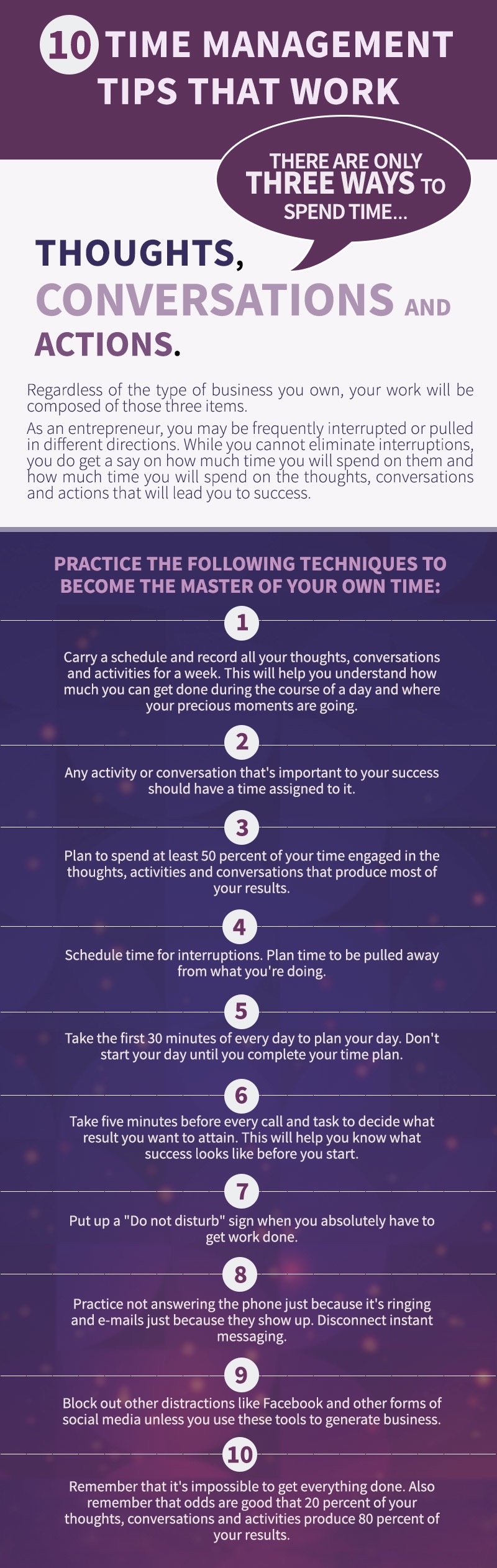
There are only three ways to spend time: thoughts, conversations and actions. Regardless of the type of business you own, your work will be composed of those three items.

As an entrepreneur, you may be frequently interrupted or pulled in different directions. While you cannot eliminate interruptions, you do get a say on how much time you will spend on them and how much time you will spend on the thoughts, conversations and actions that will lead you to success.

Here is an infographic that will help you managing your time:


1413484001-10-time-management-tips-that-work-infographic (1)

Why technology is not “the connection”

Why technology is not “the connection”

The Social Age is about connections: within networks, through technology, to communities, with each other, over time.

It’s about co-created stories: knowledge built in the moment from multiple sources and filtered through the sense-making groups we belong to.

Co-created knowledge, fragments of spare thought, aligned to build our understanding of how the world is today. And how it will be tomorrow.

And yet agility may not lie down this route. Sure, we still need control, we still need formal structures and we still need formal learning. It’s just that we also need to recognise that it’s only half of the story.

The other half is what surrounds it: wisdom, ground truth, experience. Often not so easily identifiable, deeply grounded within our communities and hard to acquire except through engagement.

We are connected through technology, and yet the technology is not, in itself, connection – it’s what we say to each other that connects us, how we treat each other, support each other, challenge and enlighten each other.

Technology is the mechanism by which we are connected, but communication is what it enables the connection, and communication is about people. About you, about me, about the stories that we share.

Often organizations talk about engagement, as if it’s something mysterious, sought after, elusive. Engagement is, in fact, everywhere. You cannot buy or bestow engagement, you can only earn it.

Those organizations stuck in the past, constrained by old models of working and older mindsets of thinking can never truly achieve engagement because they never truly want it. They never truly want what it brings – curiosity, agility, impermanence.

Young woman having business meeting in cafe with two men, smiling


Identify the people who engage naturally and do everything we can to support, nurture and recognize them, these are the first generations of Social Leaders, the connected strata who will form the foundations of our change community.

If we help these people tell our story, and shape the story, we may achieve greater connectivity with the story.

It will spread and grow under the power of amplification, rather than brute force. That’s the key to change – connection. So our role becomes facilitating, not standing at the top and trying to force the organization to become fit for the Social Age, but alongside it, nurturing and unleashing its natural potential.

It starts with reflection and grows to a community, connected around ideas, around shared values.

To change our organizations, we must create spaces and permissions to connect, and recognize those people who do so, recognize them socially. Celebrate the success that they bring.

How having more energy at work

How having more energy at work

When working with employees and first time leaders around the world, over half (56%) of them spend time on activity that takes lots of effort for very little result. In short, they’re wasting their time. Yet, just a few small adjustments to the way they work can make a big difference to their productivity.


Multi-tasking

multitasking

Despite what many believe, multi-tasking is not a great way to manage time efficiently nor to get things done: each time someone switches from one activity to another, people suffer from something similar to writer’s block and then need to take time to ‘reset’ their minds between tasks.

The more complex the tasks the more time it takes to re-organize the mind but even brief distractions add up.


Rather than multi-tasking, employees should estimate how long it will take to accomplish an activity and only focus on those things that generate a good return on investment. They should be allowed to block dedicated periods of time in their calendar and discipline themselves to focus on the task at hand during those periods.


Lack of clarity

Business man discussing a point during meeting

A lot of work gets done without the benefit of clearly defined goals and objectives but without clarity it is difficult to know whether the right work is getting done and priorities then start to clash.

Sense of meaninglessness

startup-photos-large


It’s also important for employees to set personal goals which will energize and engage but as we become busier it is easy for meaningful goals to be displaced by urgent things.  The longer this goes on, the more stressed a person becomes.


Create a flexible weekly schedule in terms of work and home-life categories of activities  job, chores, exercise, family, unstructured relaxation, and so on.


Over-committing

xr6880_how-can-you-say-youve-got-too-much-work-in-a-professional-way@2x

People over-commit for a variety of reasons: they don’t want to disappoint others; they feel they have no choice; they have an unrealistic idea of current commitments or of what is involved in the new commitment.

But those that over-commit can quickly become burnt-out and exhausted.


It’s important to create a workplace culture where it’s acceptable to say ‘no’ at times; that it doesn’t show unwillingness but rather a sign that you are responsible and take your commitments seriously.

Before saying yes, employees should let the person know that they will check their other priorities and time-frames. Before agreeing, they should have a realistic and detailed idea of what the commitment entails and if they can’t do it, then give a reason for declining.


Distractions

pexels-photo-large

We are constantly bombarded by distractions and interruptions in the workplace.

Think of these events as forcing the mind into a multi-task mode, with each event either preventing or breaking concentration and time lost to constant task switching.


To overcome distractions, employers should provide quiet places of work or flexibility to work from home for when employees are working on projects that require concentration. Employees should set aside time periods for specific activities, and discourage interruptions. Email and voicemail checking should be saved for the time between other tasks.


Lack of organization

desk-laptop-notebook-pen-large


For some people, organization means files, drawers, cubbies, neat stacks (or no stacks at all), and a complete lack of clutter. For others, it simply means knowing where to look and being able to find what you need right away.

The point of organization is not to fit someone else’s definition of ‘organized’, but for employees to have what they need in an easily accessible place.

They should be encouraged to organize themselves in a way that makes sense to them, to cull information and emails regularly and to recognize that being disorganized is a drain on their time and energy.


Lack of reflection time

fashion-person-woman-hand-large

Failing to reflect is a vicious circle as it can lead to people becoming stressed and overworked which then means even less time for thinking. This stifles creativity and innovation but also a lack of downtime means many aren’t considering their activities and whether they’re key for meeting their goals and objectives.


Employees should set aside specific time each month or week to reflect on their work, themselves and their long-term goals, and be partnered with a coach or mentor for support (this could be a manager, colleague, or friend outside work).


Perfectionism

light-red-white-home-large

Perfection is an indefinable and unobtainable goal that increases workload significantly for very little value. Employers and managers should establish objective quality measures by defining what is ‘good enough’.

But if in doubt, before ‘making it better’, they should ask themselves whether a person, whom they respect, would notice a meaningful qualitative difference if more time and effort was invested.


We can’t of course all work like robots, ensuring that every minute of the working day is used efficiently and productively. There will of course be days where people lack energy and enthusiasm either due to personal issues, ill health or just general ‘off’ days. But with the right motivational leadership in place and a few simple steps to help teams to use time effectively, then output versus activity should be evenly balanced.

Online vs face-to-face networking

Online vs face-to-face networking

When the balance is tipped towards online rather than face-to-face networking, and we step out of the bubble, it can all feel a little strange. The screen we sit behind is the ultimate shield, it protects us and from behind it we can be more confident to approach or instigate contact knowing that an online rejection is less visible to others.


Don’t lose this assurance when you set out face to face, remember that others are there for the same reasons you are, to network, explore new opportunities and develop relationships. You’d be happy to engage with the person online, so do it face to face too.

Depositphotos_27900641_original-1800x1200

So, you’re open to meeting anyone and everyone at the event, you’re happy to make the first move, but how to ensure a positive, enriching conversation? When networking online you might write or share articles to develop relationships, perhaps sending something you think would be of interest to a specific contact.


Your online content can assist to position yourself as someone with a worthwhile opinion, so make sure you are as prepared to do this face to face. Have some relevant stories to share, and introduce when the time feels right.


Although of course online networking is two way, a conversation of two or more with each party having a chance to share and have their say. Online etiquette dictates that whilst it is great to share content, it is also good to engage with what others are putting out there. Take these principles to your face-to-face networking events, talking is great but listening is key.

pexels-photo-large

Face-to-face networking isn’t that different to online networking; the most difficult part is often pulling open the doors to that spin class to be greeted with 20 expectant faces looking back at you, you imagine them questioning your fitness, your ability to perform.


Well now you can look each and every person in the eye with a confidence that comes from knowing you have all the networking skills you need.