Categoria: Event Planner Blog

Clients Don’t Buy What You Do. They Buy Why You Do It.

Clients Don’t Buy What You Do. They Buy Why You Do It.

Do you believe that events are the future? More importantly do your clients understand?

The importance of retaining a human connection externally with customers and clients and internally with staff and stakeholders, cannot be overstated. And successful connection is all about conversation, mutual understanding, and appreciation which all equals, you guessed it: Engagement.

So What Do We Mean By ‘Engagement’?

Clients Don’t Buy What You Do. They Buy Why You Do It.

Engagement is about adding value, building trust, and driving commitment. In doing so, brands and business are able to move their audiences from passive indifference to active participation.

It’s about creating authentic and meaningful interactions between people and the products and services with whom they choose to spend their valuable time. It’s no surprise to learn that the deepest connections between audiences and brands are formed through a process that takes people from watching and thinking, to feeling and doing.

Active participation at a personal level with a brand is key to establishing value and a lasting bond. So we need to get personal, get real, and start an authentic dialogue.

Social Net Worth Over Social Networks

Clients Don’t Buy What You Do. They Buy Why You Do It.

Engagement isn’t just about clicking on ads and responding to sales promotions.

Instead, we need to move away from social networking and focus on being social net worth kings – championing genuine, real connections and relationships with customers over just sticking something before them and asking them to care.

Reclaiming the people from the numbers, figures and follower counts. Because the human element that is missing from social media is experience. Real-life interaction and participation is comparable to none – and is the greatest marketing tool you could ever want or need.

That’s precisely what makes events so important. Events create the emotional energy behind the sale, the human experience element.

And no-one at all, including those in procurement, really choose a logical sales choice. They make emotional ones – buying ideas. People don’t buy what you do, they buy why you do it, and the only way to truly engage people with that why, is to offer them a direct, human experience of your brand in real life.

Events: Power to the People

Clients Don’t Buy What You Do. They Buy Why You Do It.

Of course, there are still those who might think that the live experience is the soft option. But to do so is to miss the bigger picture. It’s only when we visit a live event that we start to understand what a brand feels like, and how it behaves.

Every touchpoint or element has been designed to represent the brand, allowing for rich, immersive and powerful engagement from start to finish. And it all begins with an understanding of the consumer’s world. Rather than telling audiences that we’re interested in the same things they are, we’re proving it – like I said, people don’t buy what you do, they buy why you do it.

Events build emotional energy which is the most important facet of human connection, which therefore creates engagement and ultimately generates sales and ensures growth.

Online, no real thought or effort has to go into communicating any more, and it’s the same with the way brands operate online. With an increase in the ease of communication, there’s a decrease in what it actually means – making the individual feel important.

In Conclusion

Humans are emotional beings and so the key to growth is generating an ethos and culture that is emotionally-driven that it allows consumers to become invested in why we do what we do. And that’s something that cannot be imitated, achieved only from real face-to-face human interaction.

And what better way to connect with people than a bit of a party, right? That’s why events will always be integral to the success of businesses, brands, and retaining the loyalty of those who believe in them.

  Read the original article

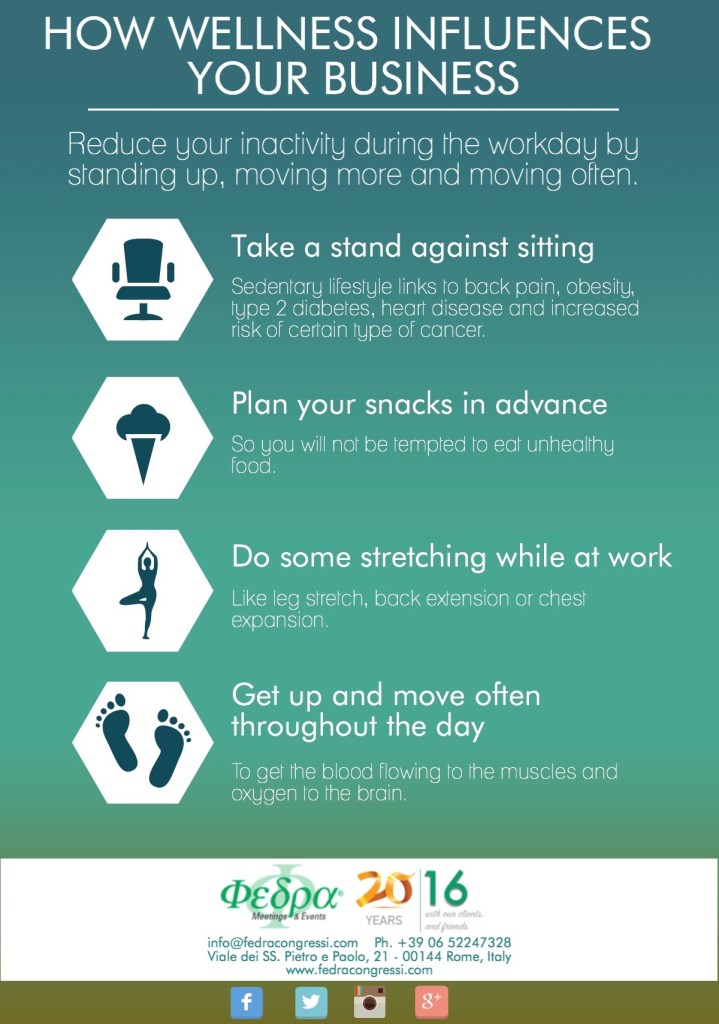
How wellness influences your business [Infographic]

How wellness influences your business [Infographic]

There are many ways to be at your best for an event.

If you can’t fix a gym session in your weekly schedule, here there are some tips you could use everyday.

how wellness influences your business

In conclusion

The benefits of brief bouts of exercise during the workday go beyond physical fitness: you are improving your ability to absorb and retain information.

If you follow this few tips, your performances at work will get better.


How to Maximize Your Meeting Productivity with Food

How to Maximize Your Meeting Productivity with Food

In general, here are the main food types to include in your plans when you want to have a productive day:

Fresh fruits

Fresh vegetables

Healthy fats (avocado, olive oil, grass-fed butter, almond butter, walnuts, macadamia nuts, etc.)

Proteins

Foods to Think Twice About Incorporating into Your Meetings

pexels-photo-large

There are some things you should generally try to avoid when eating to have a productive day at work, including:

  • Gluten (like breads and pastas)
  • Fake sugars and excess sugar
  • Donuts, muffins, pastries, etc.

The Best Breakfast Foods for a Powerful Corporate Meeting

Eggs are great for building up your brain power. Incorporating grains is also good for longer bursts of energy, so oatmeal would also be a nice, energetic choice.

The Best Lunch Foods for a Powerful Corporate Meeting

food-salad-healthy-vegetables-large

Serve plenty of healthy proteins—chicken being one of the best.  If you have vegetarians to serve as well, beans are a great substitute for meat-based protein.

Also always serve salad and vegetables and incorporate healthy fats somewhere in your meal—remember, those can include avocado, olive oil, many types of nuts (almonds, walnuts, macadamia nuts…) and a ton more.

The Best All-Day Meeting Snacks and Foods

When you have long days full of meetings, conferences and workshops, getting a really healthy, powerful meal is important.  However, what you serve as snacks in between meals is just as crucial to maintaining the energy required for a productive day.

Some snacks for your next meeting could be:

  • Almonds
  • Vegetable plates
  • Hummus
  • Fruit trays
  • Dark chocolate

These are packed with good energy to boost brain power.

Other Tips for Productive Meetings

Schermata 2016-02-23 alle 09.57.39

Eating the right food plays a vital part in determining how you will feel each day.  There are other factors, though, that are important to consider when planning for such a long day of meetings and conferences.

  • Consider the environment.  Dark conferences rooms and areas with no natural light will suck energy out of a room and don’t allow for optimal productivity.  If you simply have to use a space that is poorly lit, do what you can to lighten it up, such as displaying golden flowers, adding light-colored décor and linens, providing a clean and elegant food table setup, etc.  The little touches will make the biggest differences.
  • Take breaks.  At the very least, you group needs to take a break every 90-120 minutes.  10 minutes is an optimal amount of break time.
  • Do something with music.  Especially during your breaks, you will find that the music will uplift and reenergize the meeting attendees.  Even just half a song will be enough to stir the room.
Exercise and improve your productivity!

Exercise and improve your productivity!

Exercising at work is supposed to make you more ‘productive’, although there is very little research to support this.  A new study seeks to answer whether people perform better in their jobs on days they exercise.

The research led by the University of Bristol entitled, Exercising at work and self-reported work performance is published in the current issue of International Journal of Workplace Health Management.

The researchers examined if being active during the working day affects people’s mood and performance. Two hundred people took part in the study. They exercised on a fairly regular basis using worksite-provided facilities, such as the gym or exercise classes. Volunteers worked at one of three large, well-known companies in Bristol. They mainly held desk-based roles and rated themselves as good at their jobs.

The researchers found from the focus groups that people who built exercise into their workday experienced positive spin-offs. Exercise helped re-energise and improve concentration, made people feel calmer and particularly assisted with problem solving. Networking opportunities also seemed to thrive.

When you exercise, you are uncomfortable; but, you keep going. You walk to the end of the street, you do another rep or you run just one more minute. Being productive and getting work done at times is just really about pushing yourself to finish that sentence, make that phone call and be slightly uncomfortable. Exercise trains you on how you choose to work through discomfort.

Exercise is the secret sauce of highly effective, productive people.

Further information

The paper: Exercising at work and self-reported work performance; J. C. Coulson, J. McKenna, M. Field (pp. 176-197), International Journal of Workplace Health Management 2008; Volume 1 Issue 3.